
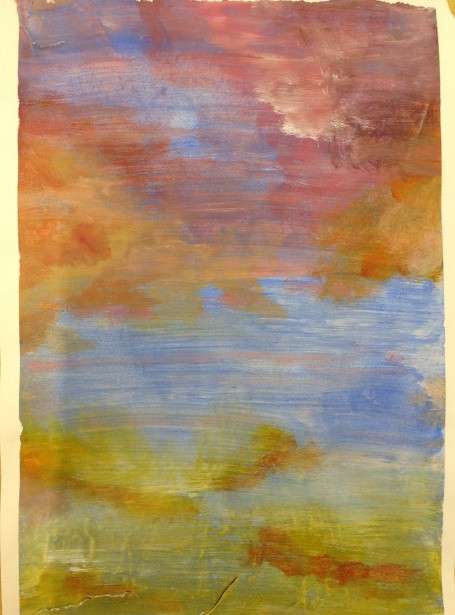
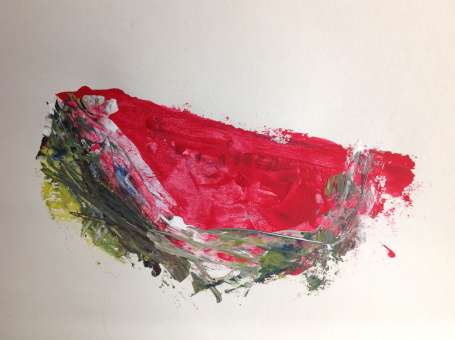
Did you know that although palette knives were used for centuries to mix paint it’s thought that it wasn’t until Rembrandt that artists actually thought to use them to apply the paint to the canvas? I suppose until then painters required the greater control that a paintbrush could give them, and the rough, scratchy marks a palette knife could give were not so interesting. More fool them I say because palette knives are amazing painting tools, as we demonstrated this week! Palette knives…
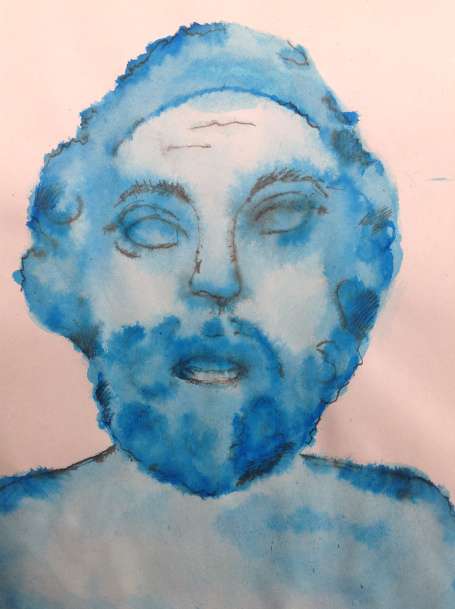
This term we are going back to basics and focusing on different painting or drawing tools. And this week it’s back to basics with our subject matter – classical sculptures. We have a few plaster casts in the studio, and I printed out some pictures of Greek and Roman statues to choose from. Taking inspiration from this Access Art session, I introduced the use of pen and ink – in which we find the shadows using a soft brush and coloured ink, using…

This week I asked the kids to make book covers. What book was up to them, and what age. I showed them some examples, and we talked about what makes a good cover, how you need to match the font to the style and content of the book, how book covers indicate for what age they are meant etc. And then of course, some weren’t satisfied with just a cover and made a whole book! Some of our older children wanted instead to…

This week I took inspiration from a painting by my grandmother, who was also an artist. She often worked with text, and in this painting she painted her letters in transparent layers so that the colours change when they overlap. The kids used coloured acetate to create a similar effect and, understandably for some, the technique suggested pictures or patterns rather than text.
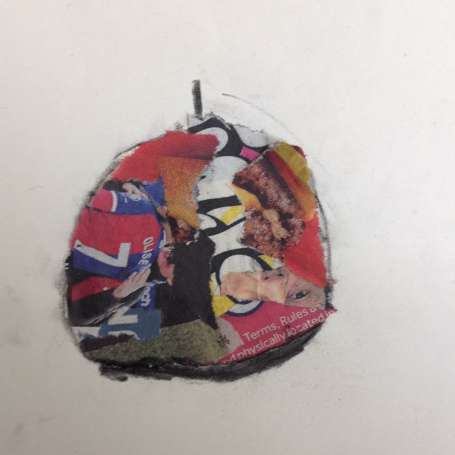
Continuing our theme of text, this time we used text (in the form of newspapers) for its different tonal values. Different sized text torn up will create different tonal shades – dark to light – and with that you have you palette and can create anything.Some also couldn’t resist adding a bit of colour from the newspapers! I assembled a group of fairly simple fruit, veg and white porcelain cups. As a warm up activity, we did ink and charcoal drawings of the…
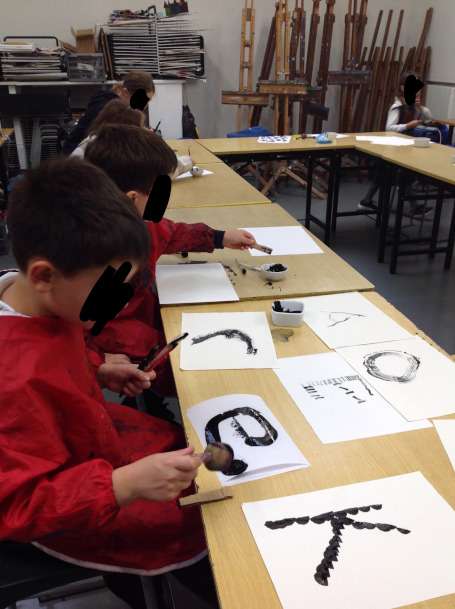
The theme for this term’s classes is text. Artists have used text in a wide variety of ways, and not always legibly. Think of Picasso’s use of newspapers in his collages, or Michaux’s development of asemic writing (week 2). Of course then there is illustration which uses text as the inspiration and comic books which marry words and images to create something else. We will look at all these are more during this term. For our first session we focused on inventing our…

This week we got to try out some millinery – using vilene (stiffened fabric), metal hair bands and sinamay (the net stuff that milliners use). AS well as my box of random fabrics. We had a wide range of designs from the pre-existing such as (tiny) top hats, witches hat and beefeater hats to the completely new such as the drooping swan and the fire hat. The stapler was invaluable here as a quick and easy way to attach the fabric without waiting…

This week we made our own looms out of cardboard (cut along two edges with pinking shears) and used them to weave amazing patterns using wool, fabric, threads, ribbons – all sorts! The colours the kids combined were fantastic. This activity suits those who like to work slowly – really getting into the zone – rather than those who are easily bored with repetitive activities. It’s also one for those who like working with different textures – all the results are just begging…

This week everyone did a lot of stabbing – though of course not themselves or each other. Needle felting works by repeatedly stabbing the fleece with a special, barbed felting needle. This mats the fibres together and the felt gradually takes on a shape or form. You can do this 2d on top of pre-felt (semi felted fabric) or 3d to make small forms (most made animals). Be careful to do the stabbing on top of a large sponge and be careful always…

This week we used wire and fabric to make amazing sculptures. The idea came from Access Art but we didn’t use plinths this time, and the kids didn’t stick to people. The basic technique is to make a simple wire sculpture – e.g. a stick figure – and to cover it in strips of fabric ( I used a sheet from a charity shop). We used thin wire to keep wrapped around the fabric to keep it in place. Then they cut up…

This week we used glue instead of hot wax to form a resist against the acrylic paint. Originating in Indonesia, in batik hot wax would be poured on using a tjanting (a kind of tiny pot on a stick with a hole in the bottom). Then when the wax is dry and hard paint is applied onto the material and it won’t go wherever the wax is. You can build up layers this way, and whatever colour is beneath the wax will be…

So this term we are exploring textiles – including felting, dying, weaving, and even construction. To kick off we started with sewing, a fundamental skill so many are denied the opportunity to learn these days. And one that will come in handy throughout the rest of the term. This wasn’t sewing as a technical exercise – instead I encouraged the children to see the thread as another way to make a mark, just like with a pencil or a brush. The size, direction…
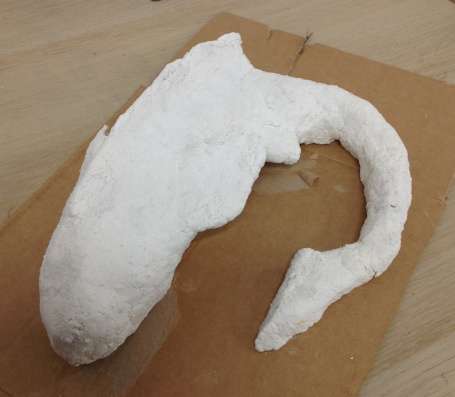
These two weeks we were busy with paper clay sculptures. Paper clay is a kind of paper mache, but the paper is mulched first before applying to the armature. I used this recipe from Jonni Good and it worked really well. The first step is to create the armature. What worked best was cardboard and scrunched up newspaper (careful to scrunch up the newspaper as tight as you can) but wire is also possible. Its really important that the sculpture is as tight…
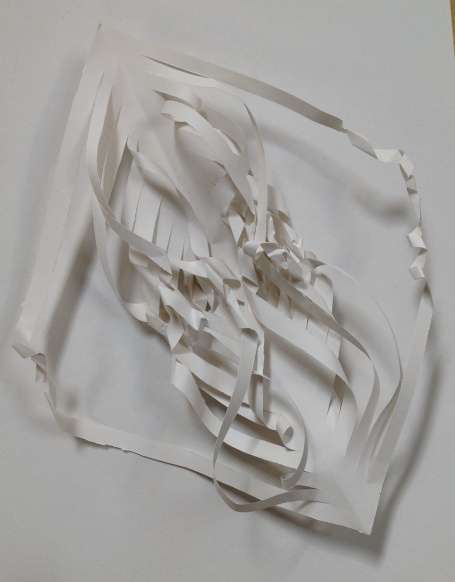
This week and I challenged everyone to make paper/card sculptures with no glue or sellotape – only stitches! We used Barbara Hepworth for inspiration, particularly her pieces involving holes and wire, and discussed how we could achieve similar effects using toilet rolls, card and thread, as well as a hole punch for the holes.. It really is amazing what shapes and forms can be created just by cutting, folding and stiching together. And while most went for abstract,,Mateo manged to make a fish!

This week the kids used all manner of pattern making techniques to create a wonderfully vibrant fashion catwalk – with cardboard human and other animal mannequins. The process was simple enough – but the results certainly weren’t. We had scarfs, saris, hats, capes, boots – you name it! Using techniques such as scarffito (sratching into wet paint to reveal a painted layer underneath) and stenciling they first made their ‘fabric’ by covering a piece of A4 paper with their pattern design. While these…

This week I showed the kids some basic, and some more complex, ways of weaving with paper. With help from Naomi Kendall, who provided this helpful post on the subject, we made some beautiful designs, using both strips of coloured paper and strips of magazines to make some v beautiful patterns. Of course, you don’t need to keep to the regular patterns I demonstrated. Some adventurous children deviated from the patterns with strips of different widths, as well as colours which did not…

Welcome to our new term! This term will be all about paper! Each week a different activity using paper (or card).. First up was tissue paper – surprisingly versatile. While of course you can make some lovely collages with tissue paper, especially using its translucency to create different colours where they overlap, and coating in diluted PVA to bring out those colours. But you can also use bleeding tissue paper to stain the paper you are working on – as one child said,…